
Wausau Address History by Era
The best source for previous residents depends on the date. Modern parcel data supplies the current PIN and tax-listing owner. Recorded documents extend the owner trail much farther back. Directories, census schedules, and newspapers supply the household layer that deeds often miss.
| Source | Years it covers | Where held | What it shows |
|---|---|---|---|
| Document-number index | 1850s to present | Marathon ROD and LandShark | Instrument, date, party lead |
| Name index | 1989 to present | LandShark | Grantor and grantee searches |
| Legal-description index | 1992 to present | LandShark | Lot, block, subdivision, condo, and metes-and-bounds routes |
| Wausau city directories | 1883 to 1942 verified; 1883 to 1979 cited but longer run needs confirmation | MCHS, MCPL, and WHS bibliography | Dated occupant, address, and status |
| Telephone directories | As early as 1899 | MCHS | Subscriber and address leads |
| Sanborn maps | As early as 1884 | MCHS and WHS | Building footprint, use, and address context |
| Federal census | Public through 1950 | NARA and library databases | Household, age, birthplace, street, and work fields |
| Wausau newspapers | Title-specific runs from 1861 through 2019, plus current digital coverage | MCPL, WHS, and licensed databases | Moves, obituaries, notices, and property clues |
| City permits | Verified online start year not located | Wausau Inspections, Evolve, or request | Construction and alteration evidence |
Start with the newest reliable record before moving backward. For early Wausau previous residents, a directory or census line may be the first clue, but the legal description is the safer bridge between old and new street labels.
Reverse the Marathon County Deed Chain
The Marathon County land-record system uses Ascent for a free index and LandShark for recorded-document searches and image access. Begin with today's parcel and owner. A grantee is the person or entity receiving an interest. A grantor transfers it. Keep those roles beside each date so the chain does not flip.
- Pull the current PIN, tax-listing owner, municipality, and abbreviated legal description from the property listing.
- Find that owner's purchase instrument and read the grantee, grantor, recording date, document number, and legal description.
- Search the seller as an earlier grantee. Confirm the parcel or legal description rather than relying only on the surname.
- Repeat through older deeds, mortgages, plats, easements, and certified survey maps, noting each portal's coverage window.
- For a gap, try document number, volume and page, PIN, date, or courthouse copies before deciding the record is absent.
LandShark warns that index and image availability can lag and old images can be hard to read. A blank result is a search condition, not proof that a transfer never occurred.
- Chain of title
- The sequence of recorded transfers affecting the same land.
- Legal description
- The recorded wording that identifies land more precisely than a postal address.
- Grantor and grantee
- The transferring party and receiving party named in an instrument.
- Enumeration district
- A census taker's assigned area, useful when an address index fails.
Wausau Deed Tabs Start Differently
LandShark's tabs do not share one start date. Document-number searching reaches back to the 1850s, name searching starts in 1989, and legal-description searching starts in 1992. That oddity matters when tracing previous residents. A deed may exist even if the name tab cannot reach its year.
The county land-information plan reports about 1.9 million recorded documents from 1853 through 2024. It also describes name, PIN, legal, subdivision, recording-date, volume-page, and instrument-type routes. Use those fields together when a trust, estate, firm, or spelling shift breaks a surname trail.
Note: Treat every portal result as an index entry until the recorded image or certified copy confirms its content.
Wausau Previous Residents in Directories
The Marathon County Historical Society verifies Wausau city directories as early as 1883 and telephone books as early as 1899. A documented directory run spans 1883 through 1942; another bibliography cites Wright's directories through 1979, but that longer run needs edition-level confirmation. Ask the repository before assuming an unbroken sequence.
A separate public catalog for Wausau reverse or criss-cross directories was not found. Ask MCHS or MCPL about street sections, telephone books, classified volumes, and directory back matter. A criss-cross directory is organized by address or phone number rather than only by surname.
The MCHS library-resources page is pictured in the capture manifest:
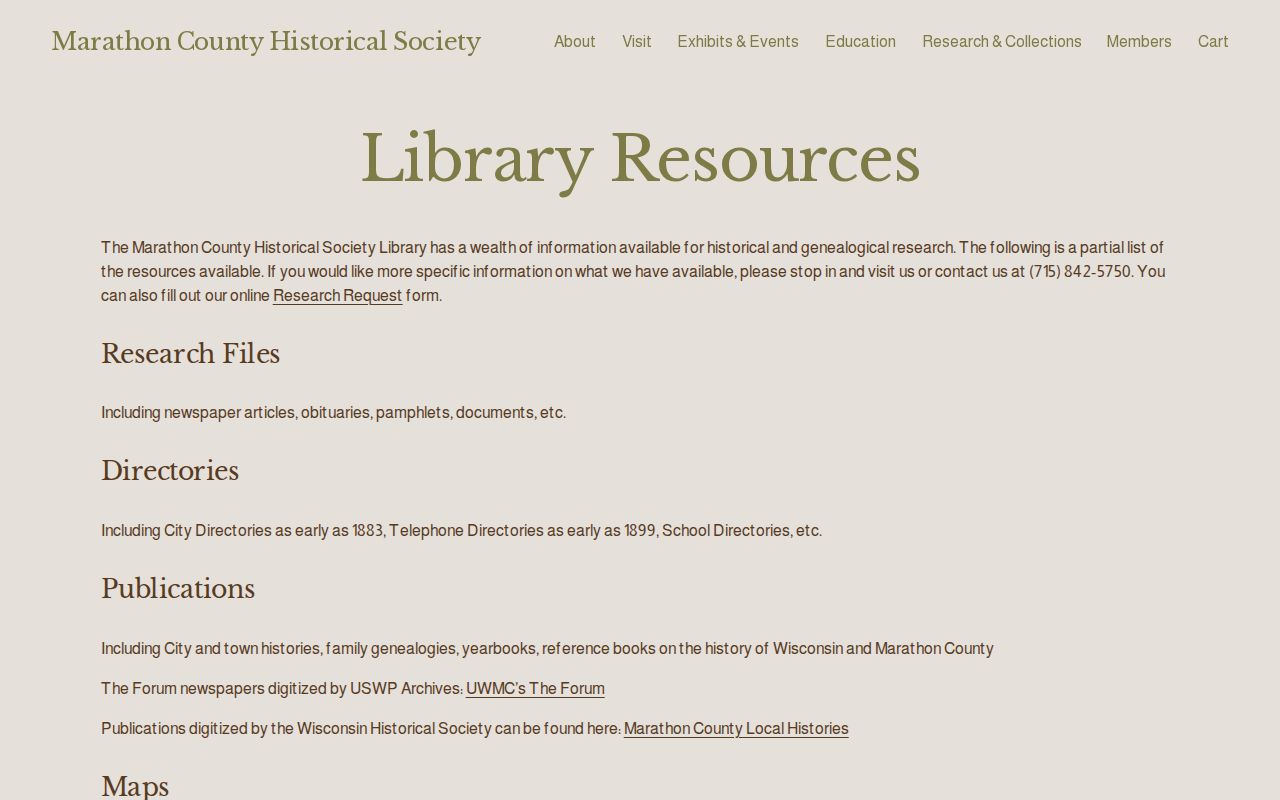
Use the page to plan a repository visit or request. Cite the exact volume, edition, and page when a line identifies past residents.
Pair Wausau Directories with Census
Deeds identify title parties, not every household member. Directories can record a name, occupation or status, spouse or widow notation, employer, and street address. Census schedules can add ages, birthplaces, family ties, and immigration details. The latest public federal population schedule is 1950 because of the 72-year rule.
- Copy the directory entry exactly, including “res” for residence or “bds” for boards.
- Check editions on both sides of the nearest public census year and mark the first and last appearance.
- Use the street and house number to locate the census page or enumeration district.
- Compare names, ages, and household ties. Do not force two similar names into one identity.
- Confirm a move or death with the page image, newspaper, vital index, obituary, or probate file.
The 1890 population schedules were largely destroyed in the 1921 Commerce Department fire. Bridge that gap with the 1890s directories, newspapers, deeds, plats, and later census evidence. Details about the volumes belong on the Wausau city directory page; this process uses them to reconstruct one address.
Sanborn Maps Test Wausau Addresses
MCHS lists Sanborn fire-insurance maps as early as 1884, maps as early as 1852, plats as early as 1882, and 1885 Intensive Survey Records. Sanborn sheets can distinguish a home from a store, school, boarding house, or industrial building at the same number. They can also reveal footprint or street-label changes between directory years.
A map does not identify an occupant by itself. Pair it with a dated directory, census line, deed, or Wisconsin Historical Society property record. When the modern parcel does not match the old number, use the county's old-new address tool and preserve both forms in the research notes.
Wausau Newspapers Close the Gaps
MCPL microfilm includes Central Wisconsin from 1861 to 1910, the Wausau Pilot from 1867 to 1940, the Daily Record-Herald from 1908 to 1974, and later Daily Herald runs through 2019. The library also describes Wausau Daily Herald digital coverage from 1907 onward in a licensed collection. Search each title rather than treating “Wausau newspaper” as one continuous file.
Moves, property sales, obituaries, civic notes, and social columns can link a person to an address between directory or census dates. OCR often drops initials and abbreviations. Read the page image before accepting a result, and save the title, issue date, page, and exact street wording.
Why Wausau Records Grow Denser
Wausau grew from 543 residents in 1860 to 30,414 in 1950. Intermediate federal counts rose through 1,349 in 1870, 4,477 in 1880, 9,253 in 1890, and 12,354 in 1900. By 1930 the city counted 23,758 people. These figures help explain why later directories, papers, and address records become denser.
The totals are city population context, not counts of people captured in a directory. Lumber, river and rail transport, manufacturing, ginseng, schools, and civic institutions offer useful search terms in old entries and newspapers. They should support a person or address trail, not replace one.
Historical Wausau Deeds Are Changing
Marathon County's 2026 request for proposals seeks scanning and indexing for about 174 historical grantor and grantee volumes. That project may improve future access to Wausau previous residents, but planned work is not the same as a public online collection. Recheck the Register of Deeds portal after production and change any coverage statement only when those records are actually searchable.
Until then, courthouse books, document citations, repository help, and the portal's existing search tabs remain the fallback chain. Wisconsin Public Records Law also permits a request for identifiable existing records, though the custodian need not create a new analysis.
Past Wausau Households Need Care
A title holder may not have lived at the property, and an occupant may never appear in a deed. Tax mailing addresses, directory entries, census pages, and permits each prove different things. Label the role and date. Probate can explain an estate transfer, but it is not a complete family directory.
Private details about living people, motor-vehicle addresses, protected voter locations, and Safe at Home actual addresses stay out of an address history. Use the smallest amount of personal detail needed to answer a family-history, estate, or property question.
Lawful use. Research Wausau previous residents for house history, genealogy, heirs, or personal curiosity. Never use address findings to track, harass, threaten, or expose a living person.