
Wausau Directory Collections by Year
Wausau city directory research begins with two local repositories. Marathon County Historical Society, or MCHS, lists city directories from at least 1883 and telephone directories from at least 1899. Marathon County Public Library, or MCPL, includes city directories and phone books in its Wisconsin Collection. A National Register nomination verifies an 1883 to 1942 run at the historical museum. A Library of Congress HABS bibliography cites Wright's Wausau City Directory from 1883 through 1979, but that longer citation should be confirmed edition by edition because its scanned text is imperfect.
| Collection | Years | Where Held | Access |
|---|---|---|---|
| Wausau City Directory | 1883-1942 verified; 1883-1979 cited | MCHS, MCPL, HABS/NPS bibliography | Confirm the edition, then cite volume and page |
| Telephone directories | As early as 1899 | MCHS research library | In-person or staff research; continuous run not published |
| Central Wisconsin digital items | Item dates vary | MCPL digitization consortium | Free online images by collection and item |
| Local newspapers | Different title runs, 1861-2019 on microfilm | MCPL microfilm and licensed databases | Library reader, database, or interlibrary route |
No official source establishes the last printed edition or an uninterrupted publisher-by-year list. Ask MCHS or MCPL whether the exact year is held before planning a visit. Record the title page, publisher, edition, and page when a volume is found. That citation matters because a broad 1883 to 1979 reference does not prove that every annual Wausau city directory survives or sits on the same shelf.
Where Wausau Directories Live
The MCHS Library Research Center at 410 McIndoe Street holds more than directory volumes. Its catalog description includes school directories, family genealogies, cemetery inscriptions, the 1905 Wisconsin State Census, maps, Sanborn fire-insurance maps, photographs, postcards, scrapbooks, and a people-and-places index. Staff research is listed at $10 per hour, plus $0.25 per copy. A precise request should name the person or address, the likely years, and the type of item sought.
MCPL's Wisconsin Collection provides a second route for Wausau city directories, maps, plat books, family histories, and government publications. When an edition is absent from one repository, ask whether the other has it or can arrange an interlibrary route. Public collection descriptions do not identify a complete obituary index or a separately cataloged reverse-directory run, so those gaps call for reference help, not a claim that no record exists.
Wausau's Digital History Companions
The Central Wisconsin Digitization Project gathers local school, railroad, library, map, and community material. Its Wausau Senior, East, West, and DC Everest yearbooks can confirm a school-era name or activity near the date of a directory entry. Search by collection and item, then cite the page or image instead of relying on a result snippet.
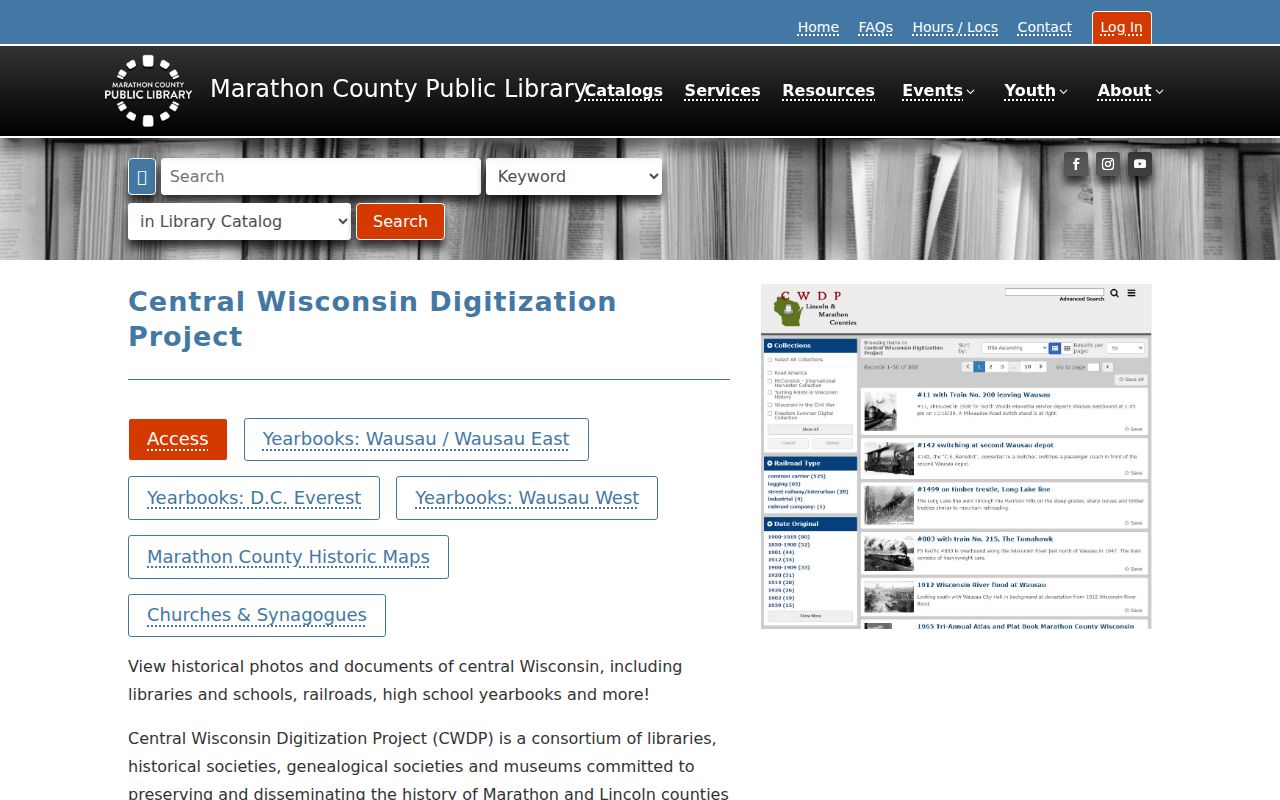
The digital collection widens the local trail, but it does not replace the directory shelf. A yearbook activity proves only that the name appeared in that school source. Match it to a directory address, census household, or newspaper page before treating two similar names as one person.
Wausau Directory Growth in Context
Wausau's fast growth helps explain why the city directory becomes richer over time. Census tables show the city at 543 people in 1860, 4,477 in 1880, 16,560 in 1910, and 30,414 in 1950. Those are population counts, not directory totals. They show why later editions can contain denser street and household detail than early volumes.
| Year | Local research milestone |
|---|---|
| 1883 | Earliest MCHS city directory year identified in the collection research |
| 1899 | Telephone directories are listed from at least this year |
| 1942 | End of the run verified by National Register material |
| 1979 | End year in the Wright's directory citation, subject to repository confirmation |
Local lumber firms, river and rail transport, Wausau Normal School, ginseng, and land agents also supply useful search words. They can distinguish two people with the same surname or point toward a business advertisement and street address.
Reading a Wausau Directory Line
An 1895 Wausau city directory image on the MCHS archive page shows the compact format researchers must decode. A line may give a name, occupation or status, street address, and a short residence or boarding mark. Some entries include a spouse, widow notation, employer, or relationship. The volume's own key controls the meaning, so photograph that key before expanding an abbreviation.
| Name | The listed person, sometimes followed by spouse or relationship text |
|---|---|
| Work or status | An occupation, employer, student status, or widow notation when printed |
| Address | House number and street as written in that edition |
| Residence mark | "res" commonly points to residence; verify it in that volume's key |
| Boarding mark | "bds" commonly means boards, not ownership of the address |
- Criss-cross directory
- An address-first list that groups entries by street and house number. No exact Wausau run has been confirmed in the public catalog.
- Householder index
- A part of a directory arranged by the person responsible for a household rather than every person at that address.
- Abbreviation key
- The publisher's list of shortened terms. It is the safest way to tell residence, boarding, occupation, and status marks apart.
A volunteer transcription of an 1890 volume can help reveal a spelling or format, but the repository scan controls. Check the printed image for dropped initials, columns, and punctuation before citing the result.
An 1895 Wausau Directory Page
The MCHS archive feature supplies a direct visual check on a historical directory page. It places the names beside the commercial and civic language of the period, which helps readers recognize how short entries and local business references were printed.
Use the scan to confirm each character, then save the item title and page citation. An image can resolve errors caused by OCR, especially where narrow columns merge a surname with an occupation or address.
Wausau Newspapers Fill Directory Gaps
MCPL microfilm provides a long set of title-specific runs: Central Wisconsin from 1861 to 1910, Wausau Pilot from 1867 to 1940, Wausau Daily Record-Herald from 1908 to 1974, Daily Herald from 1975 to 1985, and Wausau Daily Herald from 1985 to 2019. The licensed ProQuest description extends the Daily Herald trail from 1907 to the present. Search the exact surname with a street, school, church, firm, or township.
A newspaper can explain why a person vanishes between city directories. Move notices, obituaries, social columns, and property transfers may identify the date and place. OCR often loses initials and abbreviations, so inspect the page image and record the newspaper title, date, and page. No single complete official obituary index was found, which makes title-by-title searching and library staff help important.
Trace Families in Wausau Directories
Build a dated chain rather than treating one entry as a full life story. Census schedules through 1950 can add household names, ages, birthplace, marital status, and street address, depending on the form and image. The 1890 federal population schedules were largely destroyed in the 1921 Commerce Department fire, so nearby city directory years and newspapers are especially valuable for that gap.
- Find the exact name in an alphabetical section. Copy the address, work or status text, spouse or widow notation, and every abbreviation.
- Repeat the search in editions before and after that date. Preserve the printed street spelling and house number.
- Try the address section, telephone books, or address-keyed newspapers when the spelling changes or the name drops out.
- Pair the directory with the nearest open census schedule. Do not promise a match in the lost 1890 population schedules.
- Test a move or death with a newspaper, obituary, vital index, cemetery inscription, map, or property record.
A missing line can mean a move, death, name change, omission, or unlisted status. It is not proof by itself. For earlier vital events, Wisconsin Historical Society indexes and microfilm can provide leads, while the county courthouse guide lists surviving local starts of marriages in 1861, deaths in 1868, and births in 1870. An index is not a certificate, and a certificate request may require lawful eligibility.